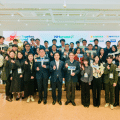
As AI moves from software into the physical world, BEYOND Expo 2026 offered a snapshot of what that transition looks like in practice — from humanoid robots and AI wearables to elder-care platforms and desktop manufacturing.
BEYOND Expo 2026 opened on May 27 at The Venetian Macao Cotai Expo, bringing together nearly 800 exhibitors, 400 speakers, and over 400 media representatives from more than 100 countries across four days. The sixth edition of what Bloomberg has called Asia’s largest tech ecosystem event ran under the theme “AI: Digital to Physical” — a deliberate pivot from the generative AI software wave that has dominated the global technology conversation since late 2022.
The theme choice was pointed. For the better part of three years, AI coverage has been dominated by large language models, chatbot interfaces, and cloud-based software tools. BEYOND Expo 2026 took a different position: that the more consequential — and less covered — story is what happens when AI leaves the screen and gets embedded into physical systems. The opening ceremony set the tone with NVIDIA’s Deepu Talla, Vice President of Robotics and Edge AI, as the first keynote speaker, a signal of where the event had positioned itself on the spectrum between software and hardware AI.
Across the exhibition floor, that thesis was visible in robotics booths drawing consistent crowds, a wearables category that has expanded well beyond fitness tracking, and a growing cluster of companies working on AI applications for aging populations, home environments, and healthcare. This is not a purely Chinese phenomenon, though the Greater Bay Area’s manufacturing infrastructure gives Chinese hardware startups a structural advantage in compressing the distance between prototype and production — a point BEYOND’s co-founder Dr. Lu Gang has made repeatedly in framing the event’s purpose.
Among hundreds of exhibitors across the four days, ten companies stood out for the clarity of their product positioning, the commercial stage they had reached, or the trends they illustrated most sharply. beSUCCESS, as official media partner of BEYOND Expo 2026, covered the exhibition floor and highlights the following.
- EngineAsI Robotics (Shenzhen) — Humanoid Robots for Industrial and Consumer Deployment
Humanoid robotics was the single most-watched category at BEYOND Expo 2026, and EngineAI Robotics — also known by its Chinese name Zhongqing Robotics (众擎机器人) — was among the companies drawing the largest sustained crowds.
The company showcased two platforms that it has been developing in parallel since its founding in October 2023 by Zhao Tongyang. The PM01 is a lightweight, highly mobile general-purpose humanoid at 1.38 metres tall, which EngineAI has described as advancing toward scaled deployment in public transportation, guided tours, retail services, and automated inspection. The T800 is a full-scale, high-efficiency universal humanoid designed for heavier industrial scenarios, making its global debut at CES 2026 in January before appearing at BEYOND.
Both platforms were demonstrated live at CES 2026, where they attracted significant attention for full-body coordination and fine motor control — as well as some controversy when the T800’s launch video prompted questions about whether its movements had been digitally enhanced. The company responded by releasing unedited behind-the-scenes footage. Whether that episode helped or hurt is debatable; it almost certainly raised the brand’s profile internationally.
EngineAI’s stated plan for 2026 is “full promotion of scenario-based verification and large-scale deployment” across industrial production, commercial services, and home companionship. That is an ambitious timeline in a sector where most companies are still at the validation stage. The humanoid robotics market is crowded with Chinese competitors including Unitree, Fourier Intelligence, and Agility Robotics globally, and the gap between compelling demos and repeatable commercial deployment remains the industry’s defining challenge.
- AlphaSpaceX (Shenzhen) — Spatial Intelligence for Physical Environments
Shenzhen-based AlphaSpaceX drew attention with a concept it calls “spatial intelligence” — AI systems designed not just to process data, but to make physical environments interactive and responsive. At BEYOND Expo, the company showcased intelligent display systems, embodied robots, digital avatars, and brain-computer interaction demos alongside an announcement of a strategic partnership around its “Retail Space Pods,” mobile AI-enabled retail units designed for commercial environments.
The company’s positioning sits at an interesting intersection between spatial computing, retail automation, and embodied AI — categories that individually have large investment narratives behind them. Whether the combination represents a coherent product strategy or an attempt to capture multiple market conversations simultaneously is a question worth watching as the company moves toward deployment. AlphaSpaceX has indicated expansion plans targeting Southeast Asia, Japan, and the Middle East.
The broader category of “spatial AI” — using artificial intelligence to understand and respond to physical space in real time — has been gaining traction as a framing device among companies working at the intersection of AR/VR, robotics, and smart infrastructure. Apple’s Vision Pro positioning has accelerated that vocabulary even among companies that are not building headset products.
- HeyBene by Build8 — AI Companions for Relationships and Families
Consumer AI startup Build8 introduced HeyBene, an AI companion platform that takes a deliberately different positioning from productivity-focused assistants. Where most AI companion products are framed around task completion or information retrieval, HeyBene targets emotional relationships and long-term memory — allowing users to share conversations, reminders, special dates, and relationship context with an AI system designed for persistent engagement over time.
At BEYOND Expo, the company showcased the HeyBene iOS app alongside tabletop hardware prototypes, signaling an intent to move into physical companion devices rather than remaining a software-only product. The roadmap toward embedded hardware is a common pattern in the AI companion space: several companies have learned that pure-software companion products face high churn once the novelty fades, while physical form factors create different retention dynamics.
The AI companion category has attracted both significant investor interest and significant regulatory scrutiny globally. Questions around data privacy, emotional dependency, and the long-term effects of AI-mediated relationships remain largely unresolved. For Build8, the challenge will be differentiating in a space that already includes well-funded competitors including Replika, Character.AI, and a growing number of Chinese players.
- Gyges Labs — Vocci AI Note-Taking Ring
Gyges Labs brought its AI note-taking ring Vocci to BEYOND Expo 2026, building on a debut the product had already made at CES 2026 in January. Vocci is designed to capture voice in a compact ring form factor, using gesture or tap activation rather than always-on listening — a privacy-conscious design choice that distinguishes it from some competitors. The device supports up to eight hours of independent recording without a phone connection and is built from aerospace-grade titanium alloy.
Gyges Labs has Silicon Valley roots — its team includes PhDs from Stanford and UCLA with experience at Google, Apple, and Hikvision, and the company previously co-launched the Halliday Glasses, which raised US$3.3 million on Kickstarter. Vocci’s target market is defined professional niches: journalists, lawyers, financial practitioners, and meeting-heavy knowledge workers, rather than the general consumer.
The wearable AI market is fragmenting rapidly. Smart rings are no longer just fitness trackers; they are becoming platforms for payments, productivity, and passive AI assistance. The question for Vocci, as with many products in this category, is whether the use case is sticky enough to sustain daily wear — or whether it becomes a product people carry to meetings and leave on the desk otherwise.
- Metlen — AI Smart Glasses
Shenzhen-based Metlen showed AI smart glasses at BEYOND Expo, positioning them around real-time contextual assistance, translation, and navigation rather than the display-and-notification model that defined earlier generations of wearable eyewear. The company describes its product as offering proactive AI assistance rather than reactive commands — glasses that notice what you are doing and offer relevant help, rather than waiting to be spoken to.
Smart glasses are currently one of the most competitive hardware categories in consumer AI. Meta’s Ray-Ban collaboration has achieved genuine commercial traction, reframing what smart glasses can look like and feel like at a price point that drove adoption. That success has pulled significant attention back to the category after years of Google Glass fatigue. Chinese hardware companies, with faster iteration cycles and lower cost structures, are well-positioned to compete in this space — if they can clear regulatory hurdles in Western markets.
The challenge for any smart glasses startup entering now is that Meta and its hardware manufacturing partners have set both price expectations and design expectations. Products need to be as unobtrusive as ordinary frames and priced within reach of mainstream consumers, requirements that have historically been at odds with the sensor and compute requirements of genuinely useful AI assistance.
- Deyin Tech — SOMO Voice AI Platform for Elderly Users
Deyin Tech showcased SOMO, a voice-driven AI agent platform designed specifically for elderly users. The platform is built around natural voice interaction and connects health services, diet management tools, mobility assistance systems, and companion robots in a single interface. The design philosophy prioritizes voice over touch — recognising that many older users are more comfortable with speech than with touchscreens — and builds in health monitoring and alert functions alongside companionship features.
Deyin Tech’s focus on the “silver economy” places it in one of Asia’s most structurally significant technology markets. Japan, South Korea, China, and Singapore all face accelerating demographic aging, and healthcare systems across the region are under intensifying pressure to find technology-assisted alternatives to labour-intensive eldercare. The silver economy technology sector is expected to become one of the largest addressable markets in Asia over the next two decades.
What makes the category genuinely difficult is that elderly users are not a homogeneous segment. A 65-year-old in an urban South Korean apartment has a very different set of needs, preferences, and technology comfort levels from a 78-year-old in rural China. Products that succeed will likely need to be adapted significantly across geographies rather than deployed as a single global solution.
- Saucein — AI-Assisted Kitchen Automation
Saucein introduced an AI seasoning machine that combines ingredient recognition, voice-guided cooking assistance, and precise seasoning control into a consumer kitchen appliance. The device tracks nutritional intake and learns personal taste preferences over time through AI-powered recommendations. The product represents the intersection of computer vision, voice interaction, and behavioural personalisation applied to a task — cooking — that most people perform daily but that very few smart home products have genuinely simplified.
AI-enhanced home appliances are a category that has promised more than it has delivered for several years. Most “smart” kitchen devices have added connectivity without meaningfully reducing friction. The more interesting products emerging from this space use computer vision and on-device AI to handle the variable, unpredictable nature of food preparation — recognising that ingredients vary, preferences change, and cooking rarely follows a fixed script. Saucein’s nutrition tracking functionality is also timely: consumer interest in personalised nutrition has grown steadily, and a device that connects cooking behaviour to dietary outcomes could find a market among health-conscious users willing to pay a premium.
- Finnox — Emotional AI Companion Robot
Finnox showcased what it calls an “AI Emotional Companion Cat,” a consumer companion robot built around what the company terms “affective intelligence infrastructure.” The device combines voice, visual, and sensor-based inputs to allow the AI system to recognise and respond to emotional signals, adjusting its behaviour based on the user’s apparent emotional state rather than only explicit commands.
Companion robotics and emotional AI have become increasingly prominent within Asia’s consumer technology ecosystem, particularly in Japan and China, where solo living is rising and social isolation among elderly populations is a documented public health concern. The companion robot market has historically struggled to bridge the gap between appealing product concepts and practical daily use — many companion robots are used intensively for weeks and then set aside.
What distinguishes products with genuine retention from those that become expensive novelties is usually the quality of the interaction model. Emotional responsiveness that feels authentic and unpredictable sustains engagement; emotional responsiveness that feels scripted and repetitive does not. Whether Finnox’s multimodal approach is sufficient to clear that bar is something that real-world user data, rather than expo demos, will determine.
- OttoBox AI Studio by Om AI Technology (Hangzhou) — AI Video Creation
While much of BEYOND Expo 2026’s floor space and attention went to physical AI systems, enterprise software tools remained a significant presence. Hangzhou-based Om AI Technology introduced OttoBox AI Studio, an AI video creation platform targeting professional creators and media production workflows. The platform combines multimodal AI models with intelligent content organisation and automated video generation features.
The AI video generation category has seen rapid development over the past 18 months, with platforms including Sora, Runway, Kling, and a growing list of Chinese competitors pushing the boundaries of what is possible with automated video creation. For a new entrant in this space, differentiation is increasingly difficult at the capability level; competitive advantages are more likely to come from workflow integration, pricing, or specialisation for specific content formats and industries.
OttoBox AI Studio’s presence at a hardware-heavy event like BEYOND Expo is itself a data point: enterprise AI software companies are increasingly using Asia’s hardware-focused events to reach media, manufacturing, and retail clients who are active buyers of AI tools even if they are not themselves building AI products.
- Makera — Makera Z1 Desktop CNC with AI-Assisted Design
Makera brought the Z1, its entry-level desktop CNC machine, to BEYOND Expo 2026 following a significant commercial milestone: the product raised over US$10 million across 6,927 backers on Kickstarter — one of the most successful crowdfunding campaigns in desktop manufacturing history — and received the CES 2026 “Best of Kickstarter” award and the French Design Award Gold Award 2025. The Z1 is priced under US$1,000 and is designed to bring precision manufacturing capability to creators, educators, and small studios who previously could not justify the cost or space of professional CNC equipment.
What makes the Z1 relevant to an AI-focused event is not just the hardware. Makera’s software ecosystem, including Makera Studio and its AI Craft tool, introduces a “text to relief” workflow that allows users with no CAD or CAM experience to describe or upload a concept and have the AI generate a 3D model with optimised toolpaths. That abstraction layer — AI as a translator between intention and manufacturing instruction — is part of a broader trend of AI being used to lower the skill barriers to previously technical processes.
The Z1 also illustrates something important about where the physical AI opportunity sits in manufacturing. The device itself is not AI-powered in the robotics sense; it is a precision machine tool. But AI is what makes it accessible. The question of where the value sits — in the hardware or in the software that enables non-experts to use it — is increasingly central to how desktop manufacturing companies will be valued as the category grows.
What BEYOND Expo 2026 Tells Us About the State of Physical AI
Taken together, the companies that drew attention at BEYOND Expo 2026 sketch a picture of physical AI that is less unified than the “AI: Digital to Physical” theme might suggest. There is no single transition happening; there are several overlapping ones, each at a different commercial maturity level and facing different structural challenges.
Humanoid robotics — the category that attracted the most floor traffic — remains the furthest from large-scale commercial deployment. The demonstrations are impressive, and the investment flowing into the sector is substantial. But the gap between controlled demo performance and reliable operation in unstructured real-world environments is still wide. Companies like EngineAI are credible engineering operations; whether they become commercially significant businesses in the next three to five years depends on progress that no conference can predict.
AI wearables are further along the commercialisation curve. Smart glasses have proven commercial viability at the Meta price point; the question for new entrants is whether there is a defensible niche below that. AI rings like Vocci are targeting professional users willing to pay a premium for specific functionality, which is a more tractable market than trying to displace general consumer devices.
The elderly-care AI category — represented at BEYOND by Deyin Tech’s SOMO and Finnox’s companion robotics — may be the most strategically important segment over the decade ahead, given Asian demographic trajectories. It is also the category where product-market fit is hardest to demonstrate at a conference, because the users who need these products most are rarely at tech expos. Success here will require deep distribution partnerships with healthcare systems and community organisations, not just compelling hardware.
The AI home appliances and creator tools categories — Saucein, Makera, OttoBox — share a common challenge: they are competing in markets where the dominant narrative is “we added AI to an existing product category.” The products that break through in these spaces will be those that make AI invisible while making outcomes meaningfully better. Makera’s text-to-manufacturing workflow is a reasonable attempt at that. Whether Saucein’s seasoning machine clears the same bar depends on whether the AI integration genuinely changes the cooking experience or simply adds a layer of complexity with a glossy interface.
BEYOND Expo’s value as an event, and its growing significance on the global technology calendar, is precisely that it surfaces these questions before they are answered. The companies on this floor are making bets about which physical AI applications will become essential rather than optional, and about whether Asian manufacturing advantages can translate into global product leadership in categories that Silicon Valley and European tech hubs have historically owned. BEYOND 2026 is a useful snapshot of where the bets are being placed.
For founders, investors, operators, and technology enthusiasts looking to understand where AI innovation is headed next, BEYOND Expo continues to position itself as one of Asia’s key platforms for emerging technology and startup discovery. As embodied AI, robotics, smart wearables, and AI-native consumer devices gain momentum globally, the event offers a firsthand look at the companies building the next generation of intelligent products. More information about upcoming editions, exhibitors, and event updates can be found at BEYOND Expo.
Related Article List
 BEYOND Expo 2026 Unveils “AI: Digital to Physical” as Its Official Theme
 beLAUNCH, Asia’s Top Startup Event in Seoul – Speaker Highlight
 Early Bird Booths & Tickets for beLAUNCH, Asia’s Biggest Startup Conference on Sale Until Jan 31st!
 The English beSUCCESS Media Team is Hiring – Apply Now
 비석세스, ‘K-스카우터 2025 데모데이’에서 글로벌 혁신 스타트업 첫 공개