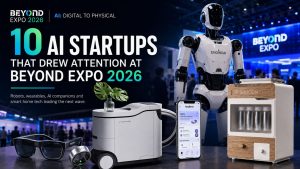
As artificial intelligence moves from software into real-world deployment, BEYOND Expo 2026 highlighted a broader shift toward ecosystem-driven innovation, global commercialization, and cross-border collaboration.
BEYOND Expo 2026 arrived in Macau at a moment when the global technology industry is entering a new phase. For much of the past three years, the conversation around artificial intelligence has been dominated by foundation models, generative AI platforms, and increasingly powerful software systems. Yet at BEYOND Expo 2026, the focus was noticeably different. As an official media partner, beSUCCESS attended sessions across the event's major forums, summits, and exhibitions to examine the themes shaping the next phase of innovation.
Across keynote sessions, startup showcases, government forums, investment discussions, creator summits, and industry panels, the conversation increasingly centered on what happens after technological breakthroughs occur. How do technologies move into the real world? How do startups scale globally? How do innovation ecosystems support commercialization? And how does artificial intelligence evolve from software into infrastructure, products, machines, and operational systems?
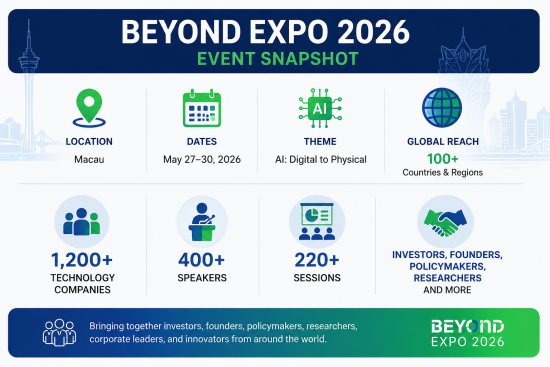
Held under the theme "AI: Digital to Physical," this year's event brought together more than 1,200 technology companies, hundreds of investors, over 400 speakers, and participants from more than 100 countries and regions. More than 220 sessions explored topics ranging from embodied intelligence and AI agents to healthcare innovation, cloud infrastructure, robotics, creator economies, venture capital, and international expansion.
This year's edition expanded far beyond a conventional technology exhibition. The program combined AI-focused discussions with startup ecosystems, venture capital, creator economies, international cooperation forums, product launches, investor matchmaking, and commercialization-focused initiatives.
Key Summits and Forums
Some of the event's most prominent sessions included:
- Physical AI Summit, focused on robotics, embodied intelligence, autonomous systems, edge AI, intelligent manufacturing, and real-world deployment of AI technologies.
- Digital AI Summit, where speakers discussed foundation models, enterprise AI adoption, AI agents, deployment infrastructure, and next-generation AI applications.
- Global Investment Summit, one of the event's flagship investor programs, bringing together venture capital firms, unicorn founders, institutional investors, and technology companies to discuss capital flows, startup scaling, and emerging sectors.
- BEYOND Wealth Summit, an invitation-only gathering of family offices, institutional allocators, investors, and industry leaders focused on wealth management, impact investing, frontier technologies, and long-term capital allocation.
- Korea Technology Forum, Indonesia Technology Forum, Asia-Europe Technology Forum, and other regional cooperation sessions exploring startup globalization, industrial partnerships, innovation ecosystems, and cross-border market expansion.
- SheTech Summit, which examined entrepreneurship, leadership, diversity, and women-led innovation across technology sectors.
- Web3 + AI Forum, focused on the convergence of artificial intelligence, blockchain infrastructure, automation, creator economies, and next-generation internet platforms.
- Gen Z Forum, SportsTech Forum, and Founder Talks, which explored creator-led businesses, startup growth strategies, emerging consumer trends, community building, and entrepreneurship.
Startup and Investment Programs
The event also featured several startup-focused initiatives:
- Fund at First Pitch (FAFP) startup competition, designed to connect founders directly with global investors.
- Business Matchmaking Program, facilitating one-on-one meetings between startups, investors, corporations, government representatives, buyers, and service providers.
- Global Investment Summit networking sessions, where founders engaged with venture capital firms, family offices, LPs, GPs, and corporate investors.
Exhibition Highlights
The exhibition floor reflected the event's broader theme of moving AI into the physical world. Attendees encountered humanoid robots, service robotics platforms, AI-powered wearables, smart glasses, intelligent manufacturing technologies, autonomous systems, healthcare innovations, enterprise AI infrastructure, cloud technologies, consumer electronics, and next-generation hardware products. Companies including NVIDIA ecosystem startups, robotics firms, AI hardware developers, and emerging technology companies used the event to showcase products aimed at real-world deployment rather than experimental demonstrations.
The event also hosted product launches, innovation showcases, hackathons, networking events, ecosystem tours, and specialized gatherings such as ClawCon Macao and AI-focused developer programs. Across different stages, industries, and forums, one theme consistently emerged: the conversation around AI is increasingly shifting from building intelligence to deploying it. Whether the discussion involved robotics, startup expansion, creator-led businesses, infrastructure, healthcare, or investment, participants repeatedly focused on commercialization, execution, and ecosystem building rather than technology development alone.
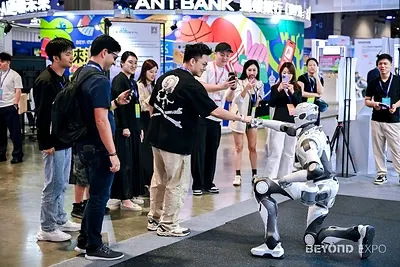
That shift became one of the defining takeaways from BEYOND Expo 2026. While the event showcased a wide range of technologies, a broader pattern emerged. BEYOND Expo 2026 suggested that the next stage of innovation may be defined less by invention itself and more by deployment, integration, and commercialization.
BEYOND Expo's emphasis on physical AI suggests that many Asian technology companies are already positioning themselves around that transition.
Asia's Innovation Advantage Is Shifting Toward Commercialization
The event also highlighted a changing perception of Asia's role within the global innovation economy. Historically, much of Asia's technology narrative revolved around manufacturing capacity, supply chains, and consumer markets. At BEYOND Expo 2026, the discussion increasingly focused on commercialization.
Across multiple sessions, speakers emphasized the ability to connect research, engineering, manufacturing, financing, distribution, and consumer adoption into integrated innovation systems.
This distinction is important. Developing new technologies remains critical. However, as AI, robotics, healthcare innovation, and consumer technology mature, competitive advantage increasingly depends on how effectively innovations can be deployed at scale.
The prominence of companies working in robotics, AI hardware, smart devices, wearables, healthcare systems, and intelligent infrastructure reinforced this theme. The event repeatedly highlighted technologies already moving beyond prototypes and entering operational environments. In many ways, BEYOND Expo reflected an ecosystem increasingly focused on execution rather than experimentation.
Globalization Is Becoming More Complex
Another recurring theme throughout the event was the changing nature of globalization. For startups, international expansion was once largely viewed as a process of entering overseas markets after establishing domestic success. Many discussions at BEYOND Expo suggested that model is becoming less effective.
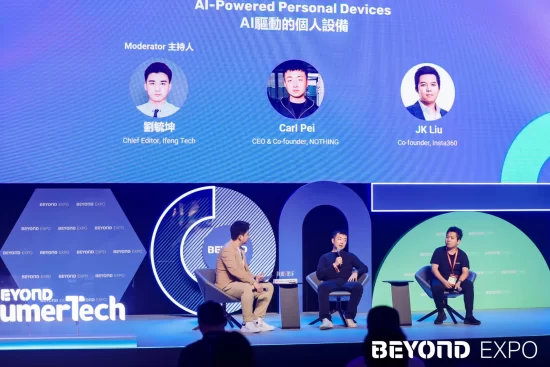
Instead, speakers repeatedly emphasized ecosystem partnerships, infrastructure readiness, localization strategies, and cross-border collaboration. During the Indonesia Technology Forum, Indonesian Ambassador to China Djauhari Oratmangun argued that future growth will depend increasingly on partnership-driven innovation.
"The future belongs to partnerships. We need to move beyond traditional buyer-seller relationships and create innovation ecosystems where countries, businesses, entrepreneurs, and institutions work together to solve challenges and create opportunities."
His comments reflected broader discussions taking place throughout the event.
As global markets become more fragmented by regulation, geopolitics, infrastructure requirements, and local consumer behavior, startups increasingly require networks rather than simple market access.
This reality was visible across multiple regional forums, including discussions involving Korea, Japan, Europe, Southeast Asia, and Latin America. The event repeatedly positioned itself as a platform connecting innovation ecosystems that increasingly operate across multiple regions rather than within single markets.
Crowdfunding, Communities, and the New Commercialization Model
One of the more unexpected themes emerged from discussions around crowdfunding and creator economies. Representatives from leading crowdfunding platforms in Japan, Taiwan, and South Korea argued that crowdfunding is increasingly being used not simply to raise capital but to validate demand, test international markets, gather customer insights, and build early communities.
This shift reflects a broader evolution in how startups commercialize products. Rather than spending years developing technologies before seeking customers, founders increasingly use communities, creators, crowdfunding platforms, and digital audiences to validate demand much earlier in the product lifecycle.
The Creator Summit reinforced similar ideas. Several speakers argued that creators increasingly operate like startup founders. They manage brands, build intellectual property, cultivate communities, diversify revenue streams, and increasingly use AI tools to improve productivity and operational efficiency.
One speaker summarized the changing nature of audience development with a simple observation: "Short form is the front door. Long form is the house." The statement resonated beyond content creation. Across industries, attention may generate visibility, but communities increasingly create long-term value.
Infrastructure Is Becoming the Foundation of Growth
A less visible but equally important theme involved infrastructure. Many discussions surrounding cloud platforms, AI deployment, compliance, and international operations pointed toward the growing importance of operational readiness. As AI becomes integrated into products, businesses, and industrial systems, infrastructure is becoming a competitive differentiator.
This includes:
- Cloud architecture
- AI deployment environments
- Data governance
- Compliance systems
- Localization capabilities
- Distributed operations
The shift reflects a broader reality within the technology sector. The challenge is no longer simply building intelligent systems. It is building the infrastructure required to operate those systems reliably across different markets and regulatory environments. As AI adoption accelerates globally, operational complexity increasingly becomes a business challenge rather than purely a technical one.
The Rise of Ecosystem Competition
Perhaps the most significant takeaway from BEYOND Expo 2026 was the growing importance of ecosystems themselves. Throughout the event, discussions repeatedly connected technologies with investment networks, startup communities, research institutions, governments, manufacturers, cloud providers, creators, and international partners.
The implication is clear. The next phase of innovation may not be won by individual companies alone. Instead, it may be shaped by ecosystems capable of connecting talent, capital, infrastructure, manufacturing, distribution, and global partnerships into cohesive innovation platforms.
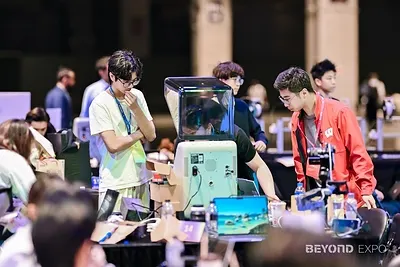
This perspective was visible across the event's structure itself. Rather than organizing conversations around isolated technologies, BEYOND Expo increasingly brought together discussions spanning AI, healthcare, robotics, investment, consumer technology, creator economies, and international collaboration. The goal appeared to be understanding how innovation systems function as interconnected networks rather than independent industries.
Looking Beyond the Technology
BEYOND Expo 2026 showcased some of the most discussed technology trends in the world, from AI agents and embodied intelligence to robotics, cloud infrastructure, creator platforms, and intelligent consumer devices. Yet the event's most important message may have been less about technology and more about what happens after innovation occurs.
Across forums, startup discussions, investment panels, and international summits, participants repeatedly focused on deployment, partnerships, infrastructure, commercialization, and ecosystem building. That focus reflects a broader shift occurring across the global technology industry.
The next generation of innovation may not be defined solely by who develops the most advanced technologies. It may increasingly be defined by who can most effectively connect those technologies with markets, communities, infrastructure, and global networks capable of turning breakthroughs into scalable impact. In that sense, BEYOND Expo 2026 offered more than a glimpse of emerging technologies. It provided a window into how the global innovation ecosystem itself is evolving.